
Step3-VL-10B: How a 10B Vision-Language Model Rivals Models 10-20x Larger
Step3-VL-10B: How a 10B Vision-Language Model Rivals Models 10-20x Larger
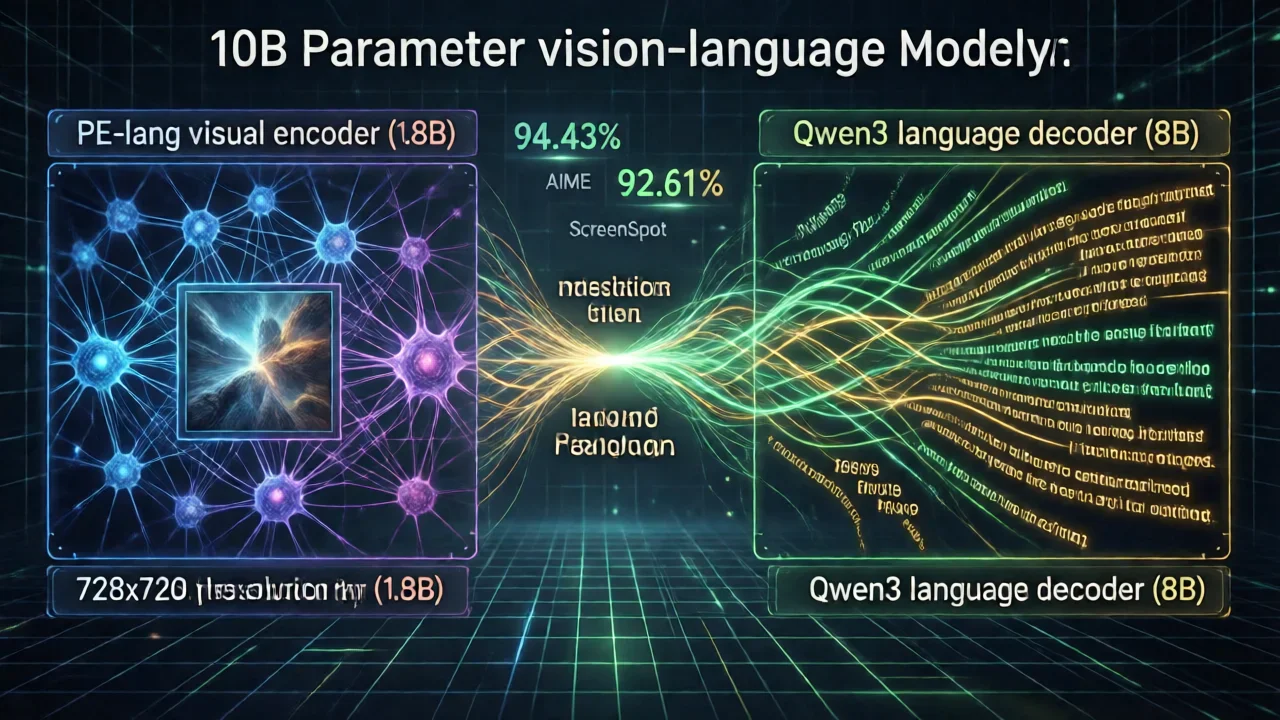
Stepfun AI just released Step3-VL-10B in January 2026. It's a 10-billion parameter vision-language model that does something unusual—it performs as well as models 10 to 20 times larger. The secret is combining a 1.8B PE-lang visual encoder with an 8B Qwen3 language decoder. If you need a vision-language model for STEM reasoning, document understanding, or GUI interaction, this one's worth a close look.
What Makes Step3-VL-10B Revolutionary?
What makes Step3-VL-10B different? Instead of just throwing more parameters at the problem, Stepfun AI designed a smarter architecture. They focused on getting more performance out of each parameter through better training and architecture choices.
The PE-lang Advantage
The key innovation is PE-lang (Language-Optimized Perception Encoder)—a 1.8B visual encoder built specifically for language-heavy tasks. Most vision encoders focus on extracting visual features. PE-lang does something different: it extracts information in a way that language models can actually reason about effectively.
Key architectural innovations:
- Multi-crop resolution strategy: 728×728 global view combined with multiple 504×504 local crops
- 16× spatial downsampling: Efficient visual token compression through two stride-2 projection layers
- Language-aligned tokenization: Visual tokens optimized for seamless integration with language models
This design philosophy explains why Step3-VL-10B excels at tasks requiring deep semantic understanding—the visual encoder is trained to extract information in a format that language models can reason about most effectively.
Unified Training Pipeline
Step3-VL-10B's exceptional performance stems from a carefully orchestrated training pipeline:
Pre-training Phase:
- 1.2 trillion tokens of multimodal data
- Single-stage, fully unfrozen training strategy
- Comprehensive coverage of visual and textual domains
Supervised Fine-tuning (SFT):
- Approximately 226 billion tokens
- Two-stage approach for progressive capability development
- Focus on instruction-following and reasoning tasks
Reinforcement Learning (RL):
- Over 1,400 RL iterations combining multiple strategies
- RLVR (Reinforcement Learning from Vision-Language Rewards)
- RLHF (Reinforcement Learning from Human Feedback)
- PaCoRe (Parallel Coordinated Reasoning) training
This multi-stage approach ensures the model develops robust reasoning capabilities while maintaining visual understanding accuracy.
Performance Benchmarks: Step3-VL-10B vs. Larger Models
The most compelling evidence of Step3-VL-10B's efficiency is its performance against significantly larger competitors.
STEM Reasoning Excellence
Step3-VL-10B demonstrates exceptional performance on mathematics and physics benchmarks:
| Benchmark | Step3-VL-10B | Larger Models | Advantage |
|---|---|---|---|
| AIME 2025 | 94.43% (PaCoRe) | ~85-90% | +4-9% |
| HMMT 2025 | 92.14% (PaCoRe) | ~80-85% | +7-12% |
| MathVision | 75.95% (PaCoRe) | ~65-70% | +6-11% |
| OCRBench | 89.00% | ~80-85% | +4-9% |
These results are particularly impressive considering Step3-VL-10B achieves them with 10-20× fewer parameters than competing models.
General Vision-Language Understanding
Beyond STEM reasoning, Step3-VL-10B maintains competitive performance across diverse benchmarks:
| Benchmark | Step3-VL-10B | Category |
|---|---|---|
| MMMU | 78.11% | Multimodal reasoning |
| MMBench (EN) | 92.05% | General visual understanding |
| MathVista | 83.97% | Mathematical visual reasoning |
| ScreenSpot-V2 | 92.61% | GUI understanding |
The ScreenSpot-V2 score is particularly noteworthy—92.61% demonstrates Step3-VL-10B's capability for understanding and interacting with user interfaces, making it valuable for automation and accessibility applications.
The PaCoRe Advantage
Many of Step3-VL-10B's top scores utilize PaCoRe (Parallel Coordinated Reasoning), an inference-time technique that aggregates 16 parallel reasoning rollouts. This approach:
- Enhances reasoning accuracy without retraining
- Increases inference cost proportionally to the number of rollouts
- Provides a tunable performance-efficiency tradeoff
- Particularly effective for complex reasoning tasks
For applications where accuracy is paramount, PaCoRe mode offers significant performance gains. For latency-sensitive applications, standard inference mode provides excellent performance with lower computational overhead.
Technical Specifications and Hardware Requirements
Understanding Step3-VL-10B's technical requirements is essential for deployment planning.
Model Architecture Details
| Component | Specification |
|---|---|
| Total Parameters | 10 billion |
| Visual Encoder (PE-lang) | 1.8 billion parameters |
| Language Decoder (Qwen3) | 8 billion parameters |
| Model Weights Size | 20 GB |
| Data Type | BF16 (Brain Float 16) |
| Visual Resolution | 728×728 global + 504×504 local crops |
| Spatial Downsampling | 16× compression |
| License | Apache 2.0 |
Hardware Requirements
Minimum Configuration for Inference:
- VRAM Required: 24 GB minimum
- Recommended GPUs: RTX 4090, A100, H100
- Model Weights: 20 GB
- Runtime Overhead: ~4 GB
- Total Memory: ~24 GB
Recommended Configuration for Production:
- VRAM: 40-80 GB (for batching and PaCoRe mode)
- GPU: A100 (80GB) or H100 (80GB)
- Storage: 30 GB (model + cache)
Software Requirements:
- Python 3.10 or later
- PyTorch ≥ 2.1.0
- Transformers 4.57.0
- CUDA 11.8 or later (for GPU inference)
Inference Format
Step3-VL-10B operates exclusively in BF16 (Brain Float 16) format. This precision level:
- Maintains numerical stability for deep reasoning
- Reduces memory requirements compared to FP32
- Provides sufficient precision for vision-language tasks
- Is widely supported by modern GPUs
Quantization to INT8 or INT4 is not officially supported, though community efforts may explore this direction.
Core Capabilities and Use Cases
Step3-VL-10B excels across multiple domains, each leveraging different aspects of its architecture.
1. STEM Problem Solving
The model's exceptional STEM reasoning performance makes it ideal for:
- Mathematics tutoring: Solving and explaining complex mathematical problems
- Physics simulations: Understanding and analyzing physics diagrams
- Chemistry visualization: Interpreting molecular structures and reactions
- Engineering analysis: Understanding technical diagrams and specifications
Example use case: A student uploads a handwritten math problem. Step3-VL-10B analyzes the image, recognizes the mathematical notation, and provides step-by-step solutions.
2. Document Understanding and OCR
With 89% OCRBench performance, Step3-VL-10B handles:
- Document digitization: Converting scanned documents to structured data
- Form processing: Extracting information from forms and applications
- Receipt analysis: Understanding and categorizing receipt content
- Invoice processing: Automated invoice data extraction
The model's multi-crop resolution strategy ensures it captures both fine details (local crops) and overall document structure (global view).
3. GUI and Screen Understanding
The 92.61% ScreenSpot-V2 score demonstrates capability for:
- UI automation: Understanding and interacting with application interfaces
- Accessibility: Describing screen content for visually impaired users
- Testing automation: Identifying UI elements for automated testing
- Mobile app analysis: Understanding mobile application layouts
4. Visual Question Answering
Step3-VL-10B can answer complex questions about images:
- Scene understanding: Describing what's happening in images
- Object relationships: Understanding spatial relationships between objects
- Contextual reasoning: Inferring information not explicitly visible
- Multi-step reasoning: Answering questions requiring multiple reasoning steps
Deployment Options
Step3-VL-10B supports multiple deployment approaches, each optimized for different use cases.
Option 1: Hugging Face Transformers (Development)
For development and experimentation, use the standard Transformers library:
from transformers import AutoProcessor, AutoModelForCausalLM

model_path = "stepfun-ai/Step3-VL-10B"
processor = AutoProcessor.from_pretrained(model_path, trust_remote_code=True)
model = AutoModelForCausalLM.from_pretrained(
    model_path,
    trust_remote_code=True,
    device_map="auto",
    torch_dtype="auto"
).eval()

# Prepare input
messages = [
    {
        "role": "user",
        "content": [
            {"type": "image", "url": "image_url_or_path"},
            {"type": "text", "text": "What's in this image?"}
        ]
    }
]

# Generate response
inputs = processor.apply_chat_template(
    messages, add_generation_prompt=True, tokenize=True,
    return_dict=True, return_tensors="pt"
).to(model.device)

generate_ids = model.generate(**inputs, max_new_tokens=1024)
response = processor.decode(generate_ids[0, inputs["input_ids"].shape[-1]:], skip_special_tokens=True)
print(response)
Advantages:
- Simple setup and experimentation
- Direct access to model internals
- Suitable for research and prototyping
Limitations:
- Single-request processing
- No built-in batching optimization
- Limited production features
Option 2: vLLM (Production API)
For production deployments requiring OpenAI-compatible APIs:
vllm serve stepfun-ai/Step3-VL-10B \
  -tp 1 \
  --reasoning-parser deepseek_r1 \
  --enable-auto-tool-choice \
  --tool-call-parser hermes \
  --trust-remote-code
Advantages:
- OpenAI-compatible API
- Efficient batching and scheduling
- Support for advanced reasoning modes
- Production-ready performance
Ideal for:
- REST API services
- Batch processing
- Multi-user applications
Option 3: SGLang (High-Performance Inference)
For maximum performance and advanced features:
sglang serve \
  --model-path stepfun-ai/Step3-VL-10B \
  --trust-remote-code \
  --port 2345 \
  --reasoning-parser deepseek-r1 \
  --tool-call-parser hermes
Advantages:
- Optimized inference performance
- Advanced scheduling algorithms
- Support for complex reasoning workflows
- Flexible deployment options
Ideal for:
- High-throughput applications
- Complex reasoning tasks
- Research and experimentation
Performance Optimization Strategies
To maximize Step3-VL-10B's efficiency in production:
1. Batch Processing
Process multiple requests simultaneously to improve GPU utilization:
- Batch size 4-8 for 24GB VRAM
- Batch size 16-32 for 80GB VRAM
- Monitor memory usage and adjust accordingly
2. PaCoRe Mode Tuning
Adjust the number of parallel rollouts based on requirements:
- Standard mode: 1 rollout (baseline performance)
- PaCoRe-4: 4 rollouts (moderate accuracy boost)
- PaCoRe-16: 16 rollouts (maximum accuracy)
3. Input Optimization
Optimize image inputs for efficiency:
- Resize images to appropriate resolution (728×728 or smaller)
- Use JPEG compression for storage efficiency
- Batch similar-sized images together
4. Caching Strategies
Implement caching for repeated queries:
- Cache model outputs for identical inputs
- Use KV-cache optimization for sequential reasoning
- Implement LRU cache for memory efficiency
Comparison with Alternative Vision-Language Models
To understand Step3-VL-10B's position in the landscape:
vs. GPT-4V (Closed-source)
Step3-VL-10B Advantages:
- Open-source and freely available
- Can be self-hosted
- Lower inference costs
- Comparable STEM reasoning performance
GPT-4V Advantages:
- Broader general knowledge
- More polished user experience
- Continuous updates and improvements
vs. Claude Vision (Closed-source)
Step3-VL-10B Advantages:
- Open-source deployment
- Specialized STEM reasoning
- Lower latency for self-hosted deployment
Claude Vision Advantages:
- Broader reasoning capabilities
- Better at nuanced understanding
- Integrated with Claude ecosystem
vs. Open-source Alternatives (LLaVA, Qwen-VL)
Step3-VL-10B Advantages:
- Superior STEM reasoning performance
- Better OCR and document understanding
- More efficient parameter usage
- Stronger GUI understanding
LLaVA/Qwen-VL Advantages:
- Smaller model variants available
- Broader community support
- More deployment examples
Getting Started with Step3-VL-10B
Step 1: Environment Setup
# Create virtual environment
python -m venv step3_env
source step3_env/bin/activate

# Install dependencies
pip install torch torchvision torchaudio --index-url https://download.pytorch.org/whl/cu118
pip install transformers>=4.57.0
pip install pillow requests
Step 2: Download Model
# Using Hugging Face CLI
huggingface-cli download stepfun-ai/Step3-VL-10B --local-dir ./step3-vl-10b
Step 3: Run Inference
from transformers import AutoProcessor, AutoModelForCausalLM
from PIL import Image
import requests

# Load model
model_path = "./step3-vl-10b"
processor = AutoProcessor.from_pretrained(model_path, trust_remote_code=True)
model = AutoModelForCausalLM.from_pretrained(
    model_path,
    trust_remote_code=True,
    device_map="auto",
    torch_dtype="auto"
).eval()

# Load image
image = Image.open("path/to/image.jpg")

# Prepare input
messages = [
    {
        "role": "user",
        "content": [
            {"type": "image", "image": image},
            {"type": "text", "text": "Analyze this image in detail."}
        ]
    }
]

# Generate response
inputs = processor.apply_chat_template(
    messages, add_generation_prompt=True, tokenize=True,
    return_dict=True, return_tensors="pt"
).to(model.device)

with torch.no_grad():
    generate_ids = model.generate(**inputs, max_new_tokens=2048)

response = processor.decode(generate_ids[0, inputs["input_ids"].shape[-1]:], skip_special_tokens=True)
print(response)
Limitations and Considerations
While Step3-VL-10B is impressive, understanding its limitations is important:
1. Inference Latency
- Requires 24GB VRAM minimum
- Inference time: 5-15 seconds per image (depending on complexity)
- PaCoRe mode increases latency proportionally
2. Knowledge Cutoff
- Training data cutoff: Early 2026
- May lack information about very recent events
- Requires fine-tuning for domain-specific knowledge
3. Language Support
- Primarily optimized for English and Chinese
- Other languages supported but with lower performance
- Multilingual reasoning may be less robust
4. Specialized Tasks
- Not optimized for real-time video processing
- Limited support for audio-visual reasoning
- May struggle with highly specialized domains without fine-tuning
Future Developments and Roadmap
The vision-language model landscape continues to evolve rapidly. Potential future developments for Step3-VL-10B include:
- Quantized variants: INT8 and INT4 versions for edge deployment
- Smaller models: 3B and 5B parameter variants for resource-constrained environments
- Multimodal extensions: Integration with audio and video understanding
- Fine-tuned variants: Domain-specific versions for specialized applications
- Improved efficiency: Further optimization of the PE-lang architecture
Conclusion
Step3-VL-10B represents a significant achievement in efficient vision-language model design. By combining innovative architecture (PE-lang encoder), sophisticated training strategies (multi-stage pipeline with RL), and careful parameter allocation (1.8B + 8B split), Stepfun AI has created a model that delivers exceptional performance while remaining practical for self-hosted deployment.
Whether you're building STEM tutoring systems, document processing pipelines, or GUI automation tools, Step3-VL-10B offers a compelling combination of capability, efficiency, and accessibility. The model's open-source Apache 2.0 license ensures you can deploy it freely in both research and commercial applications.
The era of efficient, capable vision-language models is here. Step3-VL-10B is leading the charge.
Resources: